|
|
| (191 intermediate revisions by 9 users not shown) |
| Line 1: |
Line 1: |
| | <metadesc>Communicate over USB with sensors, controllers, and relays with Phidgets! Program in macOS using a wide variety of programming languages.</metadesc> |
| [[Category:OS]] | | [[Category:OS]] |
| [[File:Icon-Mac-OS.png|64x64px|link=]] On Mac OS, Phidgets can be either plugged directly into a USB Port or run over a network using the [[#Webservice|Webservice]].
| |
|
| |
|
| __TOC__
| | ==Quick Downloads== |
| | Our libraries support macOS 10.11 and newer. |
| | * [https://cdn.phidgets.com/downloads/phidget22/tools/macos/Phidget22ControlPanel.dmg Phidget22 Control Panel] |
| | ** Recommended for Macs running macOS 10.15 or newer |
| | * [https://cdn.phidgets.com/downloads/phidget22/libraries/macos/Phidget22.dmg Phidget22 Installer] |
| | ** Legacy installer, supports macOS 10.11 and newer |
| | ** Required for working with Max and Java |
|
| |
|
| Phidgets are designed to run on '''Mac OS 10.4 or newer''', and can run on PPC, 32-bit, and 64-bit systems.
| | ===Other Resources=== |
| | * [https://cdn.phidgets.com/downloads/phidget22/libraries/macos/Phidget22_macosdevel.zip macOS Development Files] |
| | * [{{SERVER}}/downloads/phidget22/libraries/macos/Phidget22/ Previous Releases (Installer)] |
| | * [{{SERVER}}/downloads/phidget22/tools/macos/Phidget22ControlPanel/ Previous Releases (Control Panel)] |
|
| |
|
| ==Getting Started (Libraries and Drivers)== | | ==Getting Started with macOS== |
| | ===Install=== |
| | To get started, download the appropriate [[#Quick Downloads|package]] for your machine from the list above. This will install the Phidget Control Panel and the Phidget Network Server. These are powerful tools that will help you develop your Phidget applications. |
|
| |
|
| If this is your first Phidget, we highly recommend working through the Getting Started guide [[Device List|for your specific Phidget device]]. If you already have the Preference Pane Installed and know how to use it, then you've already followed the guide and are ready to learn more about the workings behind the Preference Pane, the Phidget Webservice, and more - all specific to Mac OS.
| | ===Phidget Control Panel=== |
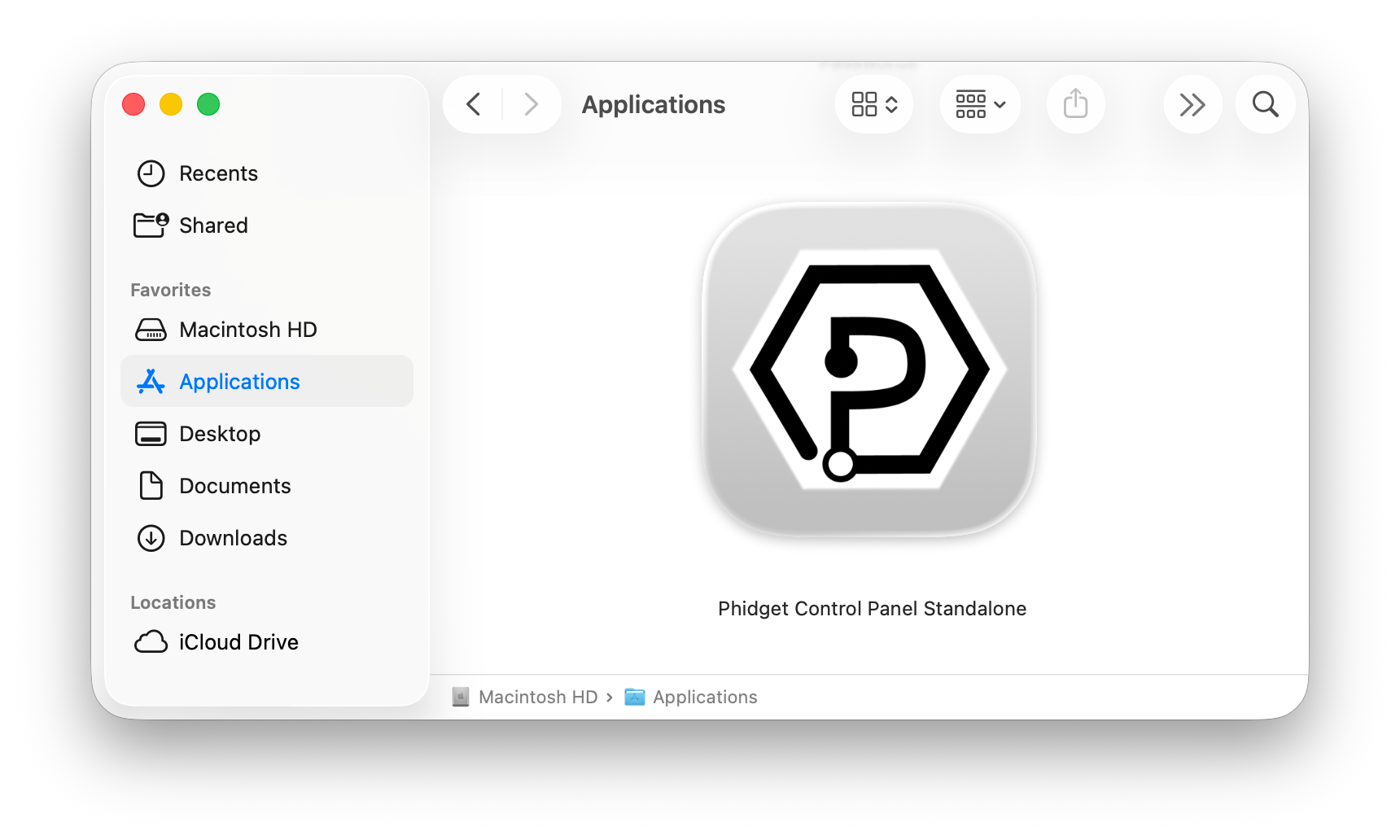
| | After downloading, drag the application into your Applications folder: |
| | [[Image:Macos_standalone_install.png|link=https://cdn.phidgets.com/docs/images/c/c8/Macos_applications_controlpanel.png|center|600px]] |
|
| |
|
| If you are already a pro, and just want the drivers:
| | You can then find the application in the Applications folder by searching for ''Phidget Control Panel''. |
| | [[Image:Macos_applications_controlpanel.png|link=https://cdn.phidgets.com/docs/images/c/c8/Macos_applications_controlpanel.png|600px|center]] |
|
| |
|
| *[http://www.phidgets.com/downloads/libraries/Phidget_2.1.8.20120216.dmg Mac OS Installer]
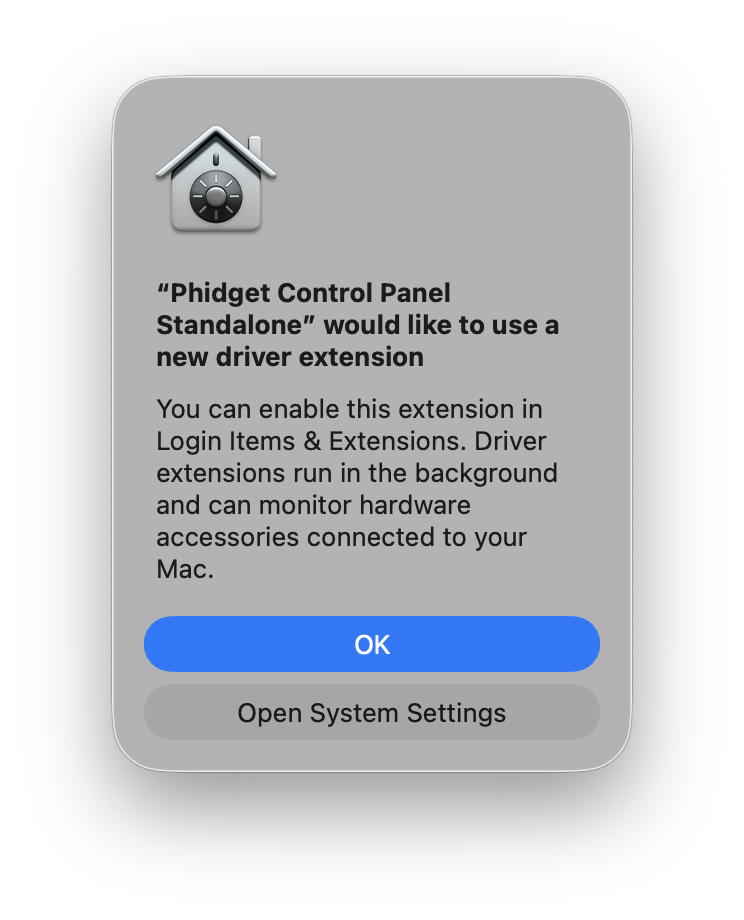
| | When you open the application for the first time, you will see the following notice: |
| | [[Image:Macos_install_extension.png|link=https://cdn.phidgets.com/docs/images/9/9e/Macos_install_extension.png|300px|center]] |
|
| |
|
| For special cases where you want to install the Phidget libraries without the installer, please see the [[#Advanced Uses | Advanced Uses]] section.
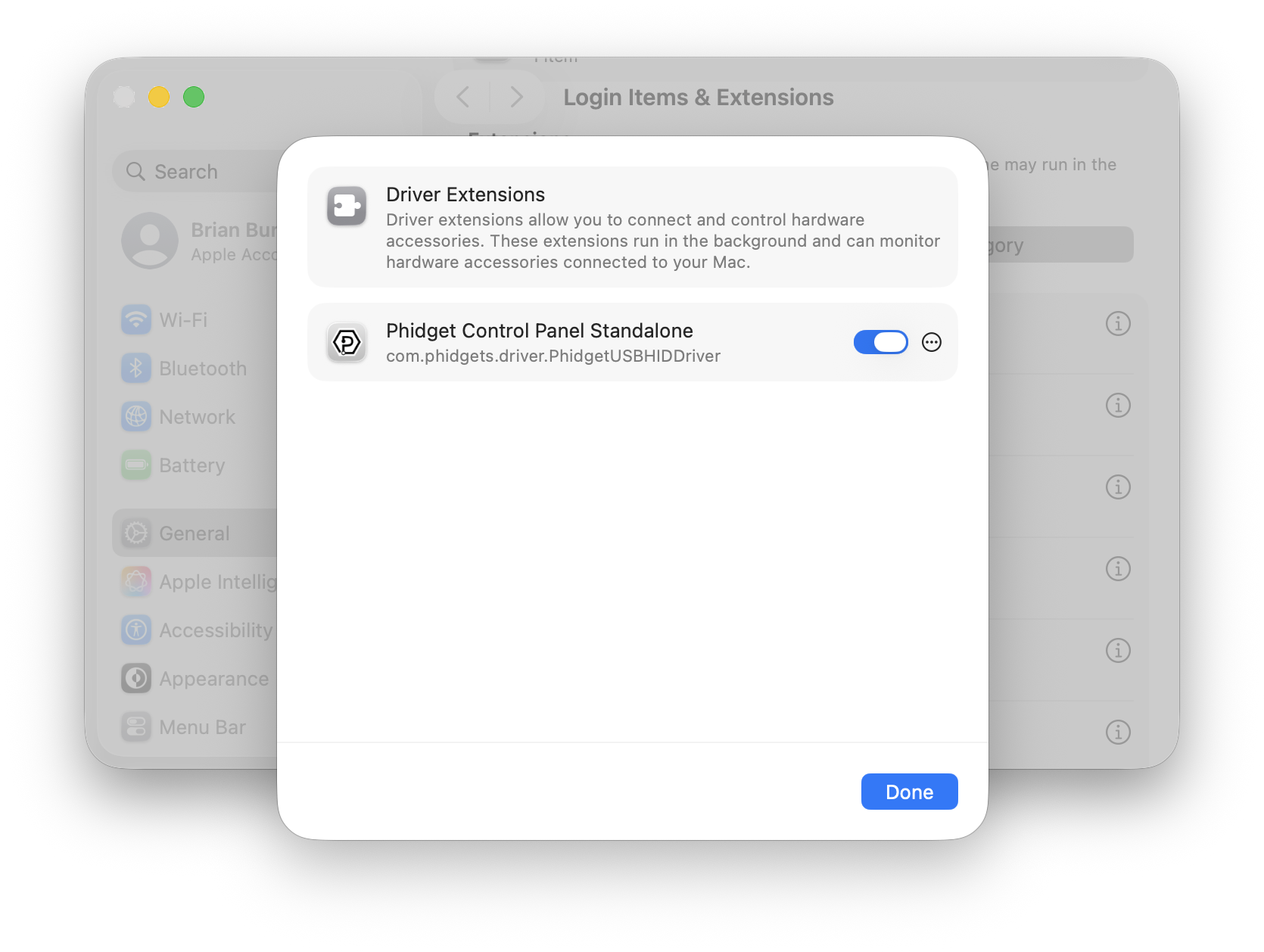
| | Follow the link in the pop-up, or navigate to ''System Settings > General > Login Items & Extensions > Extensions'', and give permissions: |
| *[http://www.phidgets.com/downloads/libraries/Phidget21-windevel_2.1.8.20110615.zip Phidget21 Libraries]
| | [[Image:Macos_install_extension_permission.png|link=https://cdn.phidgets.com/docs/images/a/ac/Macos_install_extension_permission.png|600px|center]] |
| *[http://www.phidgets.com/Drivers_Info.html#windows Software License]
| | <center>''Note: The driver extension is only required for legacy USB Phidgets running a HID USB stack. Refer to your product’s specifications page for information about its USB stack.''</center> |
|
| |
|
| ===Installing===
| |
|
| |
|
| The Phidget installer requires that your system has .NET framework 2.0 or higher. The .NET framework can be downloaded from [http://www.microsoft.com/net Microsoft]. If you do not have the .NET framework 2.0 or later installed, you can still use Phidgets. However, you won't be able to use the installer, and will have to manually install the Phidget libraries. Please see the [[#Advanced Uses | Advanced Uses]] section.
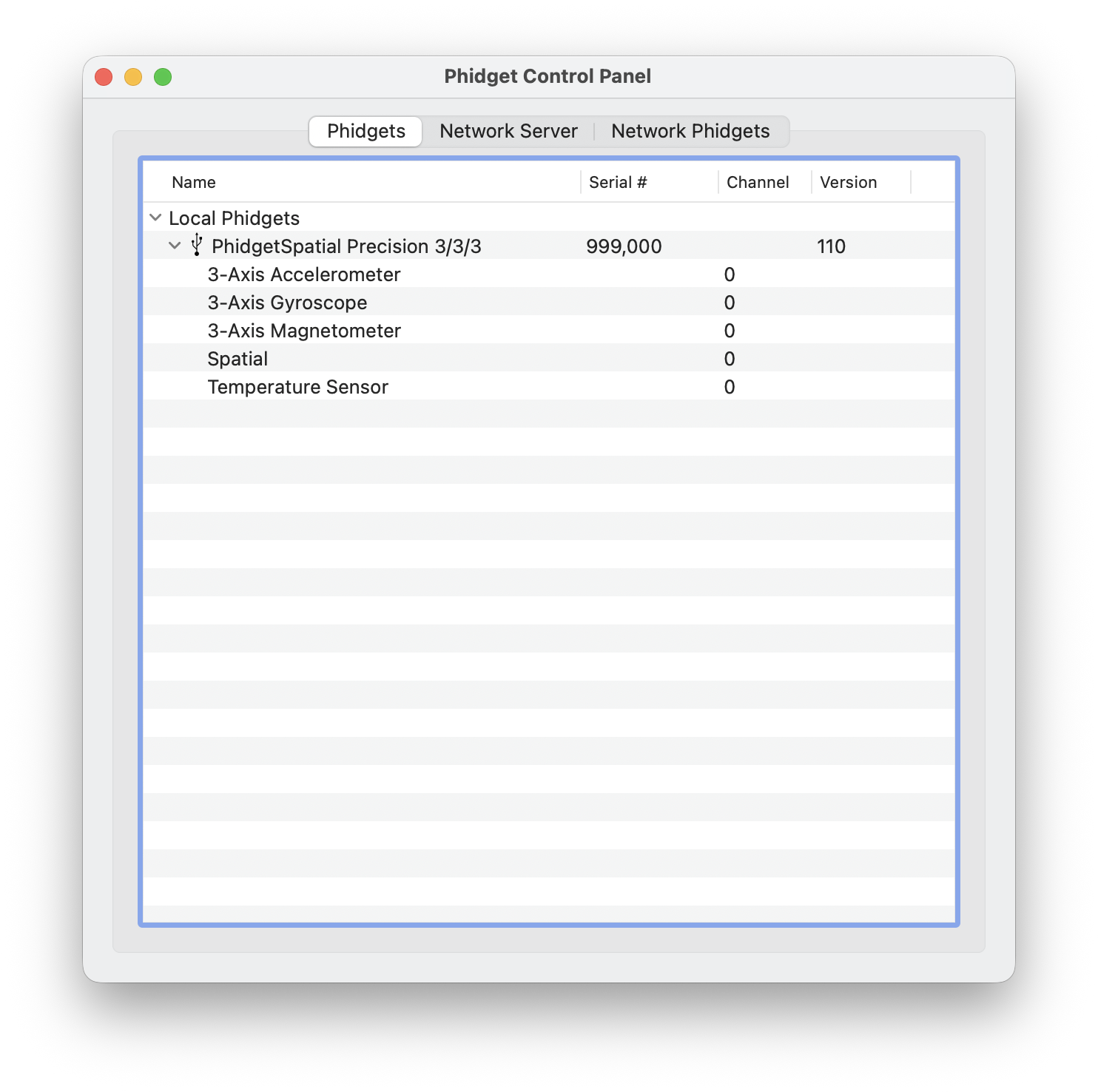
| | After running the application, you will see all the Phidgets that are plugged into your machine, as well as any Phidgets that are on your network. |
| | [[Image:Os_macos_controlpanel.png|600px|link=https://cdn.phidgets.com/docs/images/a/a1/Os_macos_controlpanel.png|center]] |
|
| |
|
| To install the libraries, follow these steps:
| |
|
| |
|
| 1. Download the Phidget installer for your system
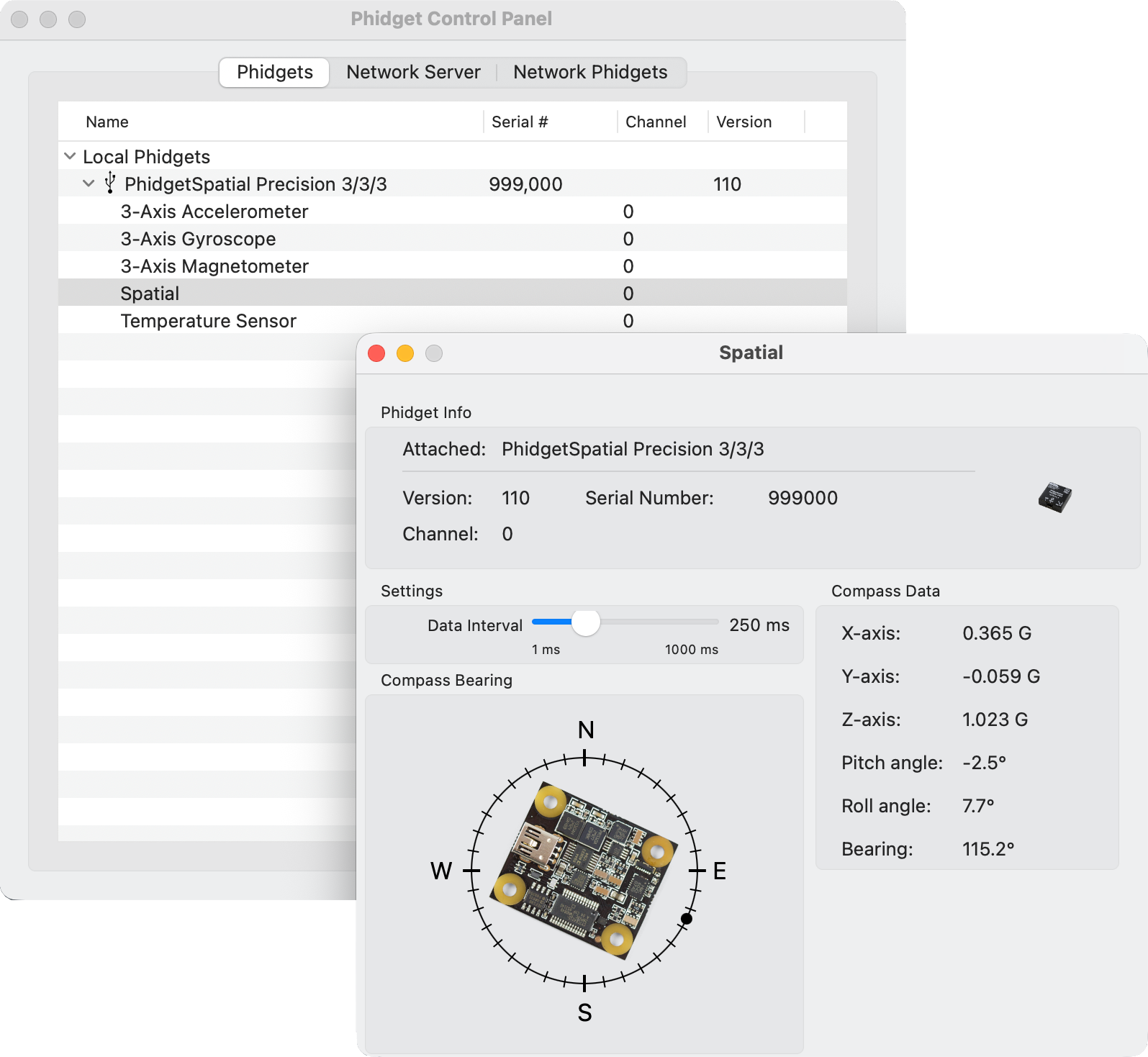
| | Click on the arrow beside a device to expand it so that you can see all available channels. Double-click on one of these channels to open up a window that lets you interact with it. |
| *[http://www.phidgets.com/downloads/libraries/Phidget_2.1.8.20120216.dmg OS X Installer]
| |
|
| |
|
| 2. Open up the installer, and double click on {{Code|Phidgets.mpkg}} to install the libraries.
| |
|
| |
|
| [[File:OSX Install 1.png|link=|alt=OS X Install]] | | [[File:Os_macos_controlpanel_example.png|link=https://cdn.phidgets.com/docs/images/3/37/Os_macos_controlpanel_example.png|center|600px]] |
|
| |
|
| 3. Proceed through the wizard.
| |
|
| |
|
| [[File:OSX Install 2.png|link=|alt=OS X Install]] | | The Phidget Control Panel can be used for testing devices, updating firmware, enabling a Phidget Network Server, and more. Visit the [[Phidget Control Panel|Phidget Control Panel page]] for more information. |
|
| |
|
| Please note that by default, the installer places the Phidget libraries in {{Code|/Library/Frameworks/Phidget21.framework}}.
| | ===Programming=== |
| | When you are ready to develop your own applications, visit our [{{SERVER}}/docs/Programming_Resources programming resources page] and select your programming language to get started. |
|
| |
|
| 4. Once the installation is complete, you are ready to program with Phidgets.
| | ==Software License== |
| | | By downloading the installer and/or development files, you agree to adhere to the terms of the [{{SERVER}}/documentation/Licenses/Phidgets_EULA.pdf Phidgets End User License Agreement]. The Phidget libraries and development files are covered by the The 3-Clause BSD License. |
| Proceed onto to the [[#Phidget Preference Pane | next]] section where the Phidget Preference Pane will be discussed.
| |
| | |
| ====Phidget Preference Pane====
| |
| | |
| The Phidget Preference Pane is a tool to quickly determine whether your system is able to control Phidgets, and also act as a debugging tool.
| |
| | |
| Once the Phidget libraries are installed using the installer, open up the {{Code|System Preferences}} window.
| |
| | |
| [[File:OSX System Preferences.png|link=|alt=OS X System Preferences]]
| |
| | |
| Click on the {{Code|Phidgets}} icon in the {{Code|Other}} section to bring up the Phidgets Preference Pane.
| |
| | |
| [[File:OSX PreferencePane General.png|link=|alt=OS X PreferencePane General]]
| |
| | |
| The general tab shows the list of Phidgets currently physically attached to the computer. You can also view the currently installed Phidget library version. You can double click on a Phidget device to open up an example program for the device.
| |
| | |
| [[File:OSX PreferencePane Example.png|link=|alt=OS X PreferencePane Example]]
| |
| | |
| In the above screenshot, the RFID example was opened. These examples are intended for demonstration and debugging purposes. If you have not yet already, please see the '''Getting Started''' guide [[Device List|for your device]]. It is important to keep in mind that when an example Phidget application is opened from the Phidget Preference Pane, it holds a lock on the Phidget. This prevents any other program from accessing the Phidget. Please ensure that this example application is closed(the Phidget Preference Pane can still be running) when you are running your own applications.
| |
| | |
| The next tab is the {{Code|Web Service}} tab, which allows you to control Phidgets over a network.
| |
| | |
| [[File:OSX PreferencePane Webservice Stopped.png|link=|alt=OS X PreferencePane Webservice Stopped]]
| |
| | |
| Here, you can start and stop the Webservice. Details are provided in the [[#Webservice | Webservice]] section. You can also determine whether the Phidget Webservice is currently running.
| |
| | |
| The next tab is the {{Code|Labels}} tab. In this section, you can view the currently assigned labels of any Phidget attached to your computer. It is also possible to set the labels of Phidgets here too.
| |
| | |
| [[File:OSX PreferencePane Labels Local.png|link=|alt=OS X PreferencePane Webservice Labels Local]]
| |
| | |
| You can also view the labels of any Phidget connected through the Webservice
| |
| | |
| [[File:OSX PreferencePane Labels Remote.png|link=|alt=OS X PreferencePane Webservice Labels Remote]]
| |
| | |
| The {{Code|Bonjour}} tab gives a list of all currently attached Phidgets that are connected to the Webservice. You can also double click on the Phidget to connect to it over the network using one or more computers, and still use the Phidget on the computer it is directly connected to. | |
| | |
| [[File:OSX PreferencePane Bonjour.png|link=|alt=OS X PreferencePane Bonjour]]
| |
| | |
| The last tab is the {{Code|PhidgetSBC}} tab, which displays the complete list of PhidgetSBCs connected to the network. You can double click on the PhidgetSBC to bring up the PhidgetSBC Adminstration Console.
| |
| | |
| [[File:OSX PreferencePane PhidgetSBC.png|link=|alt=OS X PreferencePane PhidgetSBC]]
| |
| | |
| ===Checking===
| |
| | |
| Summarize that we will be using code and the device manager to confirm and troubleshoot the installation, if needed.
| |
| | |
| ====Software====
| |
| | |
| This should walk you through compiling and running basic code against the libraries as simply as possible. Find an instance that requires no additional programs to run, and that will work with any Phidget, if possible. Recommended HelloWorld and gcc.
| |
| | |
| The point of this is to give the user tools to identify problems with the library setup that are not due to low level driver conflicts. The process should be described here (with the conclusion being the success of the check), followed by a referral to the Troubleshooting section (and content there) if failure results. See the [[OS - Linux#Software]] section for an example.
| |
| | |
| ====Hardware====
| |
| | |
| This should show you how to use the "About This Mac" program to make sure the Phidget is attached in hardware, and what to do if not.
| |
| | |
| ====Troubleshooting====
| |
| | |
| Make an in-depth point by point section with some of this content plus more:
| |
| | |
| *Confirm prerequisites
| |
| *Walk through ALL known conflicting drivers
| |
| *Suggest attributes of unknown conflicting drivers
| |
| *Get people to the troubleshooting page if a non-OS problem is suspected
| |
| | |
| See the [[OS - Linux#Troubleshooting|Linux Troubleshooting]] page for a briefer example. It is expected that with driver conflicts, this section will be much larger, with screenshots, etc. If you need to cover troubleshooting a problem with the webservice, you should put the content in the Webservice section below, and link to it.
| |
| | |
| ==Programming Languages==
| |
| We recommend the following languages for OS X:
| |
| * [[Language - Applescript|AppleScript]]
| |
| * [[Language - C/C++|C/C++]]
| |
| * [[Language - C#|C#(Using Mono)]]
| |
| * [[Language - Cocoa | Cocoa]]
| |
| * [[Language - Flash AS3 | Flash AS3]]
| |
| * [[Language - Flex AS3 | Flex AS3]]
| |
| * [[Language - LiveCode | LiveCode]]
| |
| * [[Language - Java | Java]]
| |
| * [[Language - Max/MSP|Max/MSP]]
| |
| * [[Language - Python | Python]]
| |
| * [[Language - Ruby|Ruby]]
| |
| | |
| You can also use these languages, but they do not support [[General Phidget Programming#Event Driven Code | event driven code]], and must use [[General Phidget Programming#Logic Code | logic code]] only:
| |
| | |
| *[[Language - MATLAB|MATLAB]]
| |
| *[[Language - Simulink|Simulink]]
| |
| | |
| ==Webservice==
| |
| | |
| Short description of the webservice on Mac OS (i.e. which files are the drivers, note that it is automatically on, etc)
| |
| | |
| Drivers for the Phidget Webservice on Mac are already included in the [[#Getting Started (Libraries and Drivers) | Drivers]] above.
| |
| | |
| If you have the Preference Pane installed, you already have the Webservice drivers installed.
| |
| | |
| ===Turning the Webservice On and Off===
| |
| | |
| Detailed instructions, both at runtime, and disabling from boot entirely.
| |
| | |
| ===Setting Up the Webservice===
| |
| | |
| How to find the port, computer IP, computer bonjour name, etc
| |
| | |
| ====Using the Webservice Without Bonjour====
| |
| | |
| Detailed instructions on how to change your code to work with IP addresses
| |
| | |
| ===Using the Webservice===
| |
| | |
| A walkthrough in C (using gcc) of how to write (i.e. modify) a remote program and screenshots of it running on localhost (127.0.0.1)
| |
| | |
| ===Debugging the Webservice===
| |
| | |
| Examples of common errors in webservice-using code
| |
| | |
| Is there a way to enable debugging like there is on Linux?
| |
| | |
| ==Advanced Uses==
| |
| | |
| ===Manual File Installation===
| |
| | |
| A reminder of the installer and what it does, and how to do it manually when wanting to distribute our libraries with your code.
| |
| | |
| ====Description of Files====
| |
| | |
| All files with the Preference Pane and their default installation locations.
| |
| | |
| ====Special Cases of Library Install====
| |
| | |
| Cover how customers can distribute Phidget libraries with their code, refer them mostly to their appropriate language page.
| |
| | |
| Content copied from the old page:
| |
| | |
| If you wish to only install the things you need, please refer to your language page for instructions on how to manually install the libraries for your language.
| |
| <br/> also explain even more special cases on 64bit systems, if applicable(ie, c.
| |
| | |
| ===Other Advanced Uses===
| |
| | |
| Additions to this list should be things we find people request over tech support. Ask Brian for more!
| |
| | |
| ==Common Problems and Solutions==
| |
| | |
| None, yet.
| |