|
|
| (7 intermediate revisions by 3 users not shown) |
| Line 1: |
Line 1: |
| <metadesc>Communicate over USB with sensors, controllers and relays with Phidgets! Our Java API supports Win/MacOS/Linux using Javac, NetBeans or Eclipse.</metadesc>
| | {{#seo:|description=Learn how to use Phidget USB devices with Java.}} |
| [[Category:Language]] | | [[Category:Language]] |
| __TOC__
| |
|
| |
|
| == Quick Downloads == | | ==Get Started== |
| | With the Phidget22 library, it's easy to create Java applications that work with Phidget devices. |
|
| |
|
| === Documentation === | | ==Java Libraries== |
|
| |
|
| *{{Phidget22API}} (Select Java from drop-down menu)
| | ===Source Files=== |
| | The Phidget22 Java library source files are available [https://cdn.phidgets.com/downloads/phidget22/libraries/windows/Phidget22-windevel.zip here]. |
|
| |
|
| === Example Code === | | ==Development Environment Configuration== |
|
| |
|
| *{{SampleCode|Java|Java Examples}}
| | Before choosing a development environment, make sure you have the [http://www.oracle.com/technetwork/java/index.html Java Development Kit] installed. |
|
| |
|
| === Libraries=== | | ===Javac=== |
| *[{{SERVER}}/downloads/phidget22/libraries/any/Phidget22Java.zip Java Library Download]
| | {| style="margin:auto;" class="table-no-border mw-collapsible mw-collapsed" |
| {{AllQuickDownloads}}
| | |+ '''Instructions''' |
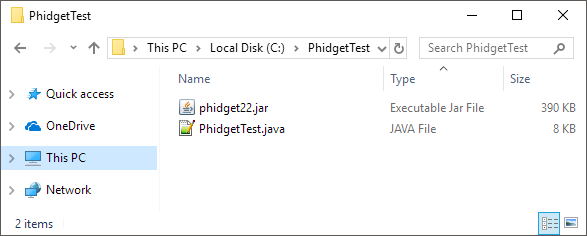
| | | |The easiest way to allow Java to access the Phidgets Java library is to place a copy of '''phidget22.jar''' in the same folder as your .java program. ||[[Image:Language_java_javac_folder.png|center|350px|link=https://cdn.phidgets.com/docs/images/8/89/Language_java_javac_folder.png]] |
| ==Getting Started with Java==
| | |- |
| Welcome to using Phidgets with Java! By using Java, you will have access to the complete Phidget22 API, including events. We also provide example code in Java for all Phidget devices.
| | |[https://www.phidgets.com/downloads/phidget22/libraries/any/Phidget22Java.zip You can download phidget22.jar here].|| |
| | | |- |
| Phidget22 supports Java SE versions 7 and up.
| | |Once you are ready to run your program, enter the following command in the command prompt or terminal: |
| | | <syntaxhighlight> |
| If you are developing for Windows, keep reading. Otherwise, select your operating system to jump ahead:
| |
| *[[#macOS | macOS]]
| |
| *[[#Linux | Linux]]
| |
| | |
| == Windows ==
| |
| {{Windows_Languages}}
| |
| ===Javac (Command Line)===
| |
| ====Use Our Examples====
| |
| One of the best ways to start programming with Phidgets is to use our example code as a guide. In order to run the examples, you will need to download and install the Java Development Kit from [http://www.oracle.com/technetwork/java/index.html Oracle].
| |
| | |
| | |
| Next, select an example that will work with your Phidget:
| |
| *{{SampleCode|Java|Java Examples}}
| |
| | |
| | |
| Copy phidget22.jar from the following location:
| |
| *C:\Program Files\Phidgets\Phidget22\phidget22.jar
| |
| | |
| | |
| Place both the example file and the phidget22.jar file in the same location. Your folder should now look something like this:
| |
| [[Image:Java_javac_folder.png|link= | center]]
| |
| | |
| | |
| Open the command prompt at the folder location. Next, enter the following command in the command prompt:
| |
| <syntaxhighlight lang="java"> | |
| javac -classpath .;phidget22.jar example.java | | javac -classpath .;phidget22.jar example.java |
| </syntaxhighlight> | | </syntaxhighlight> |
|
| |
|
| |
| Finally, enter the following command to run the program:
| |
| <syntaxhighlight lang="java">
| |
| java -classpath .;phidget22.jar example
| |
| </syntaxhighlight>
| |
|
| |
|
| |
| [[Image:Java_javac.PNG|link= | center]]
| |
|
| |
|
| |
| You should now have the example up and running for your device. Play around with the device and experiment with some of the functionality. When you are ready, the next step is configuring your project and writing your own code!
| |
|
| |
| ====Configure Your Project====
| |
| When you are building a project from scratch, or adding Phidget functionality to an existing project, you'll need to configure your development environment to properly link the Phidget Java library.
| |
|
| |
|
| |
| To include the Phidget Java library, add the following import to the top of your code:
| |
| <syntaxhighlight lang="java">
| |
| import com.phidget22.*
| |
| </syntaxhighlight>
| |
|
| |
| You can now compile the file as shown in the previous section.
| |
|
| |
|
| |
| The project now has access to Phidgets. Next, view the [[#Write Code | write your own code]] section located below.
| |
|
| |
| ===NetBeans===
| |
| ====Use Our Examples====
| |
| One of the best ways to start programming with Phidgets is to use our example code as a guide. In order to run the examples, you will need to download and install [https://netbeans.org/ NetBeans].
| |
|
| |
|
| |
| Now that you have NetBeans installed, select an example that will work with your Phidget:
| |
| *{{SampleCode|Java|Java Examples}}
| |
|
| |
|
| |
| Next, open NetBeans and create a new project:
| |
| [[Image:Java_netbeans_newproject.PNG|link=|center]]
| |
|
| |
|
| |
| Give your project a name and finish creating the project:
| |
| [[Image:Java_netbeans_nameproject.PNG|link= |center]]
| |
|
| |
|
| |
| Delete the java file that was generated with the project:
| |
| [[Image:Java_netbeans_deletefile.png|link= |center]]
| |
|
| |
|
| |
| Replace the deleted file with the example file that you downloaded. Next, add a reference to phidget22.jar by right-clicking on the libraries folder:
| |
| [[Image:Java_netbeans_addjar.png|link= |center]]
| |
|
| |
|
| |
|
| |
| You can find phidget22.jar at the following location:
| |
| *C:\Program Files\Phidgets\Phidget22\phidget22.jar
| |
|
| |
|
| |
| [[Image:Java_netbeans_jarpath.png|link=|center]]
| |
|
| |
|
| |
| After pressing run and selecting the main class, the example will be up and running for your device. Play around with the device and experiment with some of the functionality. When you are ready, the next step is configuring your project and writing your own code!
| |
|
| |
| ====Configure Your Project====
| |
| When you are building a project from scratch, or adding Phidget functionality to an existing project, you'll need to configure your development environment to properly link the Phidget Java library.
| |
|
| |
| To start, open NetBeans and create a new project:
| |
| [[Image:Java_netbeans_newproject.PNG|link=|center]]
| |
|
| |
|
| |
| Give your project a name and finish creating the project:
| |
| [[Image:Java_netbeans_nameproject.PNG|link= |center]]
| |
|
| |
|
| |
| Next, add a reference to phidget22.jar by right-clicking on the libraries folder:
| |
| [[Image:Java_netbeans_addjar_v3.png|link= |center]]
| |
|
| |
|
| |
| You can find phidget22.jar at the following location:
| |
| *C:\Program Files\Phidgets\Phidget22\phidget22.jar
| |
|
| |
|
| |
| [[Image:Java_netbeans_jarpath.png|link=|center]]
| |
|
| |
|
| |
| Finally, to include the Phidget Java library, add the following import to the top of your code:
| |
| <syntaxhighlight lang="java">
| |
| import com.phidget22.*
| |
| </syntaxhighlight>
| |
|
| |
| The project now has access to Phidgets. Next, view the [[#Write Code | write your own code]] section located below.
| |
|
| |
| ===Eclipse===
| |
| ====Use Our Examples====
| |
| One of the best ways to start programming with Phidgets is to use our example code as a guide. In order to run the examples, you will need to download and install [https://www.eclipse.org/downloads/ Eclipse].
| |
|
| |
|
| |
| Now that you have Eclipse installed, select an example that will work with your Phidget:
| |
| *{{SampleCode|Java|Java Examples}}
| |
|
| |
|
| |
| Next, create a new Java project:
| |
| [[Image:Java_eclipse_newproject.PNG|link=| center]]
| |
|
| |
|
| |
| Click ''Next >'' and add phidget22.jar to your project as an external jar:
| |
| [[Image:Java_eclipse_addjar.png|link=| center]]
| |
|
| |
|
| |
| Finally, drag the example java file into the src folder that has been created for you and run the example:
| |
| [[Image:Java_eclipse_run.png|link=|center]]
| |
|
| |
|
| |
| You should now have the example up and running for your device. Play around with the device and experiment with some of the functionality. When you are ready, the next step is configuring your project and writing your own code!
| |
|
| |
| ====Configure Your Project====
| |
| When you are building a project from scratch, or adding Phidget functionality to an existing project, you'll need to configure your development environment to properly link the Phidget Java library.
| |
|
| |
|
| |
| To include the Phidget Java library, add the following import to the top of your code:
| |
| <syntaxhighlight lang="java">
| |
| import com.phidget22.*
| |
| </syntaxhighlight>
| |
|
| |
| You can now create your project as shown in the previous section.
| |
|
| |
|
| |
| The project now has access to Phidgets. Next, view the [[#Write Code | write your own code]] section located below.
| |
|
| |
| ==macOS==
| |
| {{macOS_Languages}}
| |
| ===Javac (Terminal)===
| |
| ====Use Our Examples====
| |
| One of the best ways to start programming with Phidgets is to use our example code as a guide. In order to run the examples, you will need to download and install the Java Development Kit from [http://www.oracle.com/technetwork/java/index.html Oracle]. You will also need a copy of [{{SERVER}}/downloads/phidget22/libraries/any/Phidget22Java.zip phidget22.jar].
| |
|
| |
|
| |
| Next, select an example that will work with your Phidget:
| |
| *{{SampleCode|Java|Java Examples}}
| |
|
| |
|
| |
| Place both the example file and the phidget22.jar file in the same location. Your folder should now look something like this:
| |
| [[Image:Java_mac_javac_folder.png|link=|center]]
| |
|
| |
|
| |
| Open the terminal at the folder location. Next, enter the following command:
| |
|
| |
| <syntaxhighlight lang="java">
| |
| javac -classpath .:phidget22.jar example.java
| |
| </syntaxhighlight>
| |
|
| |
|
| |
| Finally, enter the following command to run the program:
| |
|
| |
| <syntaxhighlight lang="java">
| |
| java -classpath .:phidget22.jar example
| |
| </syntaxhighlight>
| |
|
| |
|
| |
| [[Image:Java_mac_javac_run.png|link=|center]]
| |
|
| |
|
| |
| You should now have the example up and running for your device. Play around with the device and experiment with some of the functionality. When you are ready, the next step is configuring your project and writing your own code!
| |
|
| |
| ====Configure Your Project====
| |
| When you are building a project from scratch, or adding Phidget functionality to an existing project, you'll need to configure your development environment to properly link the Phidget Java library.
| |
|
| |
|
| |
| To include the Phidget Java library, add the following import to the top of your code:
| |
| <syntaxhighlight lang="java">
| |
| import com.phidget22.*
| |
| </syntaxhighlight>
| |
|
| |
| You can now compile your project as shown in the previous section.
| |
|
| |
|
| |
| The project now has access to Phidgets. Next, view the [[#Write Code | write your own code]] section located below.
| |
|
| |
| ===NetBeans===
| |
| ====Use Our Examples====
| |
| One of the best ways to start programming with Phidgets is to use our example code as a guide. In order to run the examples, you will need to download and install [https://netbeans.org/ NetBeans]. You will also need a copy of [{{SERVER}}/downloads/phidget22/libraries/any/Phidget22Java.zip phidget22.jar].
| |
|
| |
|
| |
| Now that you have NetBeans installed, select an example that will work with your Phidget:
| |
| *{{SampleCode|Java|Java Examples}}
| |
|
| |
|
| |
| Next, open NetBeans and create a new project:
| |
| [[Image:Java_netbeans_mac_newproject.png|link=|center]]
| |
|
| |
|
| |
| Give your project a name and finish creating the project:
| |
| [[Image:Java_netbeans_mac_nameproject.png|link=|center]]
| |
|
| |
|
| |
| Delete the file that was generated with the project:
| |
| [[Image:Java_netbeans_mac_delete.png|link=|center]]
| |
|
| |
|
| |
| Replace the deleted file with the example you downloaded:
| |
| [[Image:Java_netbeans_mac_replace.png|link=|center]]
| |
|
| |
| Next, add a reference to the phidget22.jar you downloaded above by right-clicking on the libraries folder:
| |
| [[Image:Java_netbeans_mac_addjar.png|link=|center]]
| |
|
| |
|
| |
| After pressing run and selecting the main class, the example will be up and running for your device. Play around with the device and experiment with some of the functionality. When you are ready, the next step is configuring your project and writing your own code!
| |
|
| |
| ====Configure Your Project====
| |
| When you are building a project from scratch, or adding Phidget functionality to an existing project, you'll need to configure your development environment to properly link the Phidget Java library.
| |
|
| |
|
| |
| To include the Phidget Java library, add the following import to the top of your code:
| |
| <syntaxhighlight lang="java">
| |
| import com.phidget22.*
| |
| </syntaxhighlight>
| |
|
| |
| You can now create your project as shown in the previous section.
| |
|
| |
|
| |
| The project now has access to Phidgets. Next, view the [[#Write Code | write your own code]] section located below.
| |
|
| |
| ===Eclipse===
| |
| ====Use Our Examples====
| |
| One of the best ways to start programming with Phidgets is to use our example code as a guide. In order to run the examples, you will need to download and install [https://www.eclipse.org/downloads/ Eclipse].You will also need a copy of [{{SERVER}}/downloads/phidget22/libraries/any/Phidget22Java.zip phidget22.jar].
| |
|
| |
|
| |
| Now that you have Eclipse installed, select an example that will work with your Phidget:
| |
| *{{SampleCode|Java|Java Examples}}
| |
|
| |
|
| |
| Next, create a new Java project. Give it the same name as the example you downloaded above:
| |
|
| |
| [[Image:Java_eclipse_mac_newproject.png|link=|center]]
| |
|
| |
|
| |
| Click ''Next >'' and add phidget22.jar to your project as an external jar:
| |
| [[Image:Java_eclipse_mac_addjar.png|link=| center]]
| |
|
| |
|
| |
| Finally, drag the example java file into the src folder that has been created for you and run the example:
| |
|
| |
| [[Image:Java_eclipse_mac_run.png|link=|center]]
| |
|
| |
|
| |
| You should now have the example up and running for your device. Play around with the device and experiment with some of the functionality. When you are ready, the next step is configuring your project and writing your own code!
| |
|
| |
| ====Configure Your Project====
| |
| When you are building a project from scratch, or adding Phidget functionality to an existing project, you'll need to configure your development environment to properly link the Phidget Java library.
| |
|
| |
|
| |
| To include the Phidget Java library, add the following import to the top of your code:
| |
| <syntaxhighlight lang="java">
| |
| import com.phidget22.*
| |
| </syntaxhighlight>
| |
|
| |
| You can now create your project as shown in the previous section.
| |
|
| |
|
| |
| The project now has access to Phidgets. Next, view the [[#Write Code | write your own code]] section located below.
| |
|
| |
| == Linux ==
| |
| {{Linux_Languages}}
| |
| ===Javac (Terminal)===
| |
| ====Use Our Examples====
| |
| One of the best ways to start programming with Phidgets is to use our example code as a guide. In order to run the examples, you will need to download and install the JDK. You can do this by entering the following command in the terminal (where VERSION is replaced with your preferred version number):
| |
| <syntaxhighlight lang='bash'>
| |
| apt-get install openjdk-VERSION-jdk
| |
| </syntaxhighlight>
| |
|
| |
| Before continuing, ensure your JDK version matches your JRE version:
| |
| <syntaxhighlight lang='bash'>
| |
| javac -version
| |
| java -version
| |
| </syntaxhighlight>
| |
|
| |
|
| |
| You will also need a copy of [{{SERVER}}/downloads/phidget22/libraries/any/Phidget22Java.zip phidget22.jar].
| |
|
| |
|
| |
| Now that you have the JDK installed and phidget22.jar on hand, select an example that will work with your Phidget:
| |
| *{{SampleCode|Java|Java Examples}}
| |
|
| |
|
| |
| Your project folder should now look something like this:
| |
| [[Image:Java_javac_linux_folder.PNG|link=|center]]
| |
|
| |
|
| |
| Next, open the terminal at the folder location and enter the following command:
| |
| <syntaxhighlight lang='bash'>
| |
| javac -classpath .:phidget22.jar example.java
| |
| </syntaxhighlight>
| |
|
| |
| Finally, enter the following command to run the program: | | Finally, enter the following command to run the program: |
| <syntaxhighlight lang='bash'> | | <syntaxhighlight> |
| java -classpath .:phidget22.jar example | | java -classpath .;phidget22.jar example |
| </syntaxhighlight>
| |
| | |
| | |
| [[Image:Java_javac_linux_run.PNG|link=|center]]
| |
| | |
| | |
| You should now have the example up and running for your device. Play around with the device and experiment with some of the functionality. When you are ready, the next step is configuring your project and writing your own code!
| |
| | |
| ====Configure Your Project====
| |
| When you are building a project from scratch, or adding Phidget functionality to an existing project, you'll need to configure your development environment to properly link the Phidget Java library.
| |
| | |
| | |
| To include the Phidget Java library, add the following import to the top of your code:
| |
| <syntaxhighlight lang="java">
| |
| import com.phidget22.*
| |
| </syntaxhighlight>
| |
| | |
| You can now compile the file as shown in the previous section.
| |
| | |
| | |
| The project now has access to Phidgets. Next, view the [[#Write Code | write your own code]] section located below.
| |
| | |
| ===NetBeans===
| |
| ====Use Our Examples====
| |
| One of the best ways to start programming with Phidgets is to use our example code as a guide. In order to run the examples, you will need to download and install [https://netbeans.org/ NetBeans]. You will also need a copy of [{{SERVER}}/downloads/phidget22/libraries/any/Phidget22Java.zip phidget22.jar].
| |
| | |
| | |
| Now that you have NetBeans installed, select an example that will work with your Phidget:
| |
| *{{SampleCode|Java|Java Examples}}
| |
| | |
| | |
| Next, open NetBeans and create a new project:
| |
| [[Image:Java_netbeans_linux_newproject.PNG|link=|center]]
| |
| | |
| | |
| Give your project a name and finish creating the project:
| |
| [[Image:Java_netbeans_linux_nameproject.PNG|link= |center]]
| |
| | |
| | |
| Delete the java file that was generated with the project:
| |
| [[Image:Java_netbeans_linux_delete.png|link= |center]]
| |
| | |
| | |
| Replace the deleted file with the example file that you downloaded. Next, add a reference to phidget22.jar by right-clicking on the libraries folder:
| |
| [[Image:Java_netbeans_linux_addjar.png|link= |center]]
| |
| | |
| | |
| [[Image:Java_netbeans_linux_jarpath.png|link=|center]]
| |
| | |
| | |
| Before you run the example, you may need to set up your Udev rules. An explanation on how to do this is provided on the Linux OS page, which can be accessed [[OS - Linux#Setting udev Rules | here]].
| |
| | |
| | |
| After pressing run and selecting the main class, the example will be up and running for your device. Play around with the device and experiment with some of the functionality. When you are ready, the next step is configuring your project and writing your own code!
| |
| | |
| ====Configure Your Project====
| |
| When you are building a project from scratch, or adding Phidget functionality to an existing project, you'll need to configure your development environment to properly link the Phidget Java library.
| |
| | |
| | |
| To include the Phidget Java library, add the following import to the top of your code:
| |
| <syntaxhighlight lang="java">
| |
| import com.phidget22.*
| |
| </syntaxhighlight> | | </syntaxhighlight> |
| | || |
| | |- |
| | |} |
|
| |
|
| You can now create your project as shown in the previous section. | | ===Netbeans=== |
| | | {| style="margin:auto;" class="table-no-border mw-collapsible mw-collapsed" |
| | | |+ '''Instructions''' |
| The project now has access to Phidgets. Next, view the [[#Write Code | write your own code]] section located below. | | |The easiest way to allow Java to access the Phidgets Java library is to place a copy of '''phidget22.jar''' in the same folder as your .java program. ||[[Image:Language_java_javac_folder.png|center|350px|link=https://cdn.phidgets.com/docs/images/8/89/Language_java_javac_folder.png]] |
| | |- |
| | |[https://www.phidgets.com/downloads/phidget22/libraries/any/Phidget22Java.zip You can download phidget22.jar here].|| |
| | |- |
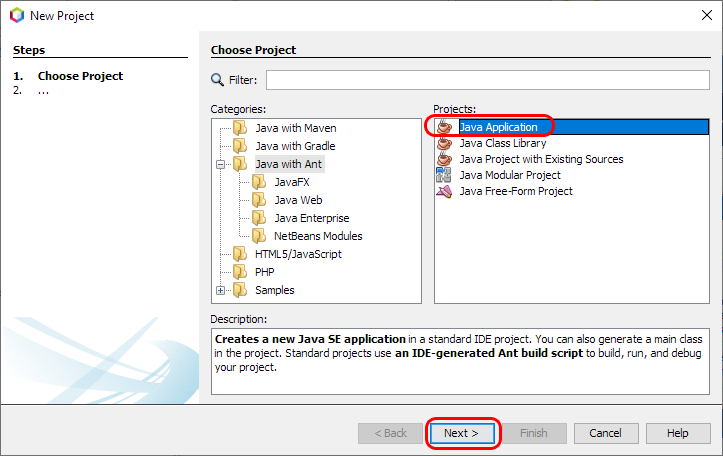
| | | To start, open NetBeans and create a new project. Select Java Application and follow the steps as directed by Netbeans.|| [[Image:Windows_netbeans1.jpg|center|350px|link=https://cdn.phidgets.com/docs/images/c/c9/Windows_netbeans1.jpg]] |
| | |- |
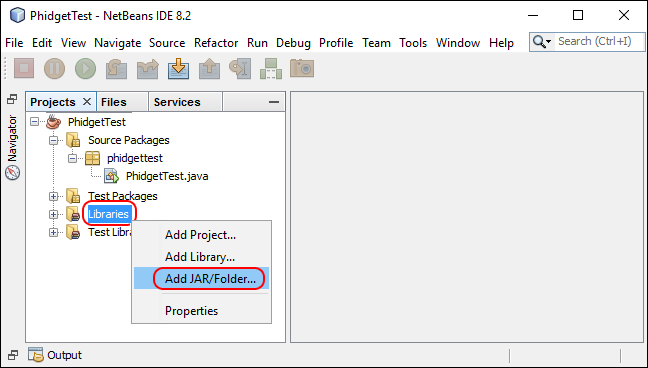
| | | Next, add a reference to phidget22.jar by right-clicking on the libraries folder. || [[Image:Windows_netbeans2.jpg|center|350px|link=https://cdn.phidgets.com/docs/images/2/2b/Windows_netbeans2.jpg]] |
| | |- |
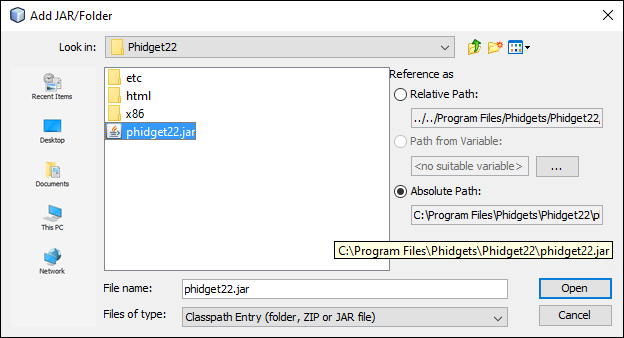
| | | Navigate to the folder where you downloaded phidget22.jar, and select it. || [[Image:Windows_netbeans3.jpg|center|350px|link=https://cdn.phidgets.com/docs/images/7/76/Windows_netbeans3.jpg]] |
| | |- |
| | | The project now has access to Phidgets. || |
| | |} |
|
| |
|
| ===Eclipse=== | | ===Eclipse=== |
| ====Use Our Examples==== | | {| style="margin:auto;" class="table-no-border mw-collapsible mw-collapsed" |
| One of the best ways to start programming with Phidgets is to use our example code as a guide. In order to run the examples, you will need to download and install [https://www.eclipse.org/downloads/ Eclipse]. You will also need a copy of [{{SERVER}}/downloads/phidget22/libraries/any/Phidget22Java.zip phidget22.jar].
| | |+ '''Instructions''' |
| | | |The easiest way to allow Java to access the Phidgets Java library is to place a copy of '''phidget22.jar''' in the same folder as your .java program. ||[[Image:Language_java_javac_folder.png|center|350px|link=https://cdn.phidgets.com/docs/images/8/89/Language_java_javac_folder.png]] |
| | | |- |
| Now that you have Eclipse installed, select an example that will work with your Phidget:
| | |[https://www.phidgets.com/downloads/phidget22/libraries/any/Phidget22Java.zip You can download phidget22.jar here].|| |
| *{{SampleCode|Java|Java Examples}}
| | |- |
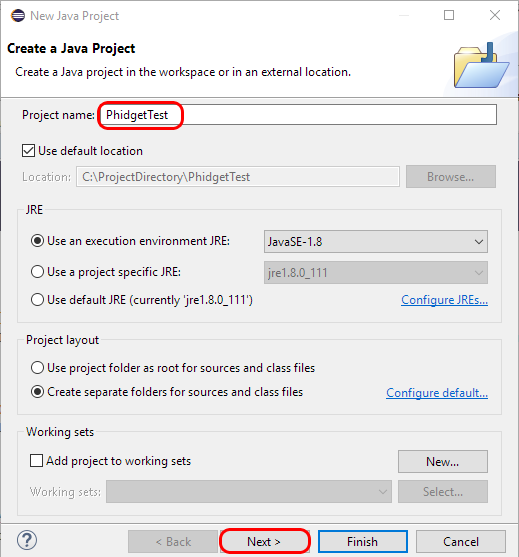
| | | | To start, open Eclipse and create a new Java project.|| [[Image:Windows_eclipse1.jpg|center|350px|link=https://cdn.phidgets.com/docs/images/3/3a/Windows_eclipse1.jpg]] |
| | | |- |
| Next, create a new Java project. Give it the same name as the example you downloaded above:
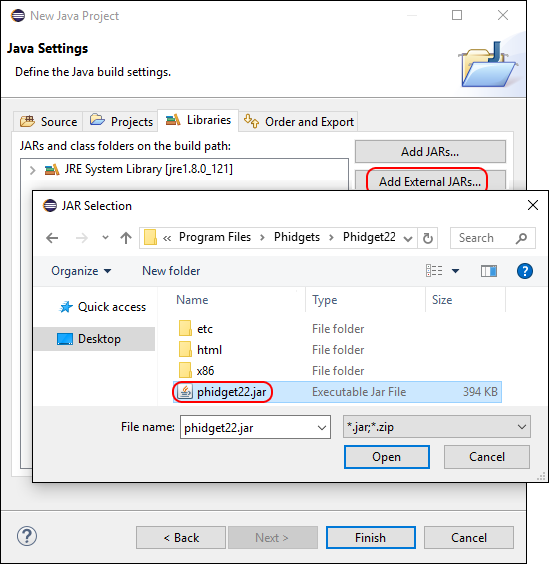
| | | On the Libraries tab, click Add External JARs and add phidget22.jar to your project as an external jar. || [[Image:Windows_eclipse2.jpg|center|350px|link=https://cdn.phidgets.com/docs/images/0/0c/Windows_eclipse2.jpg]] |
| | | |- |
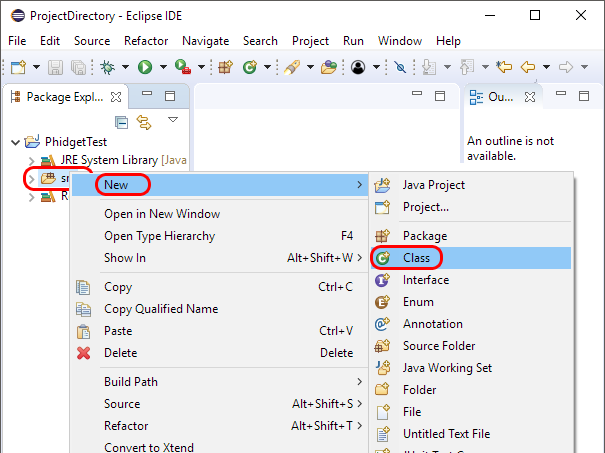
| [[Image:Java_eclipse_linux_newproject.PNG|link=| center]] | | | Create a new Class in your project. || [[Image:Windows_eclipse3.jpg|center|350px|link=https://cdn.phidgets.com/docs/images/d/d9/Windows_eclipse3.jpg]] |
| | | |- |
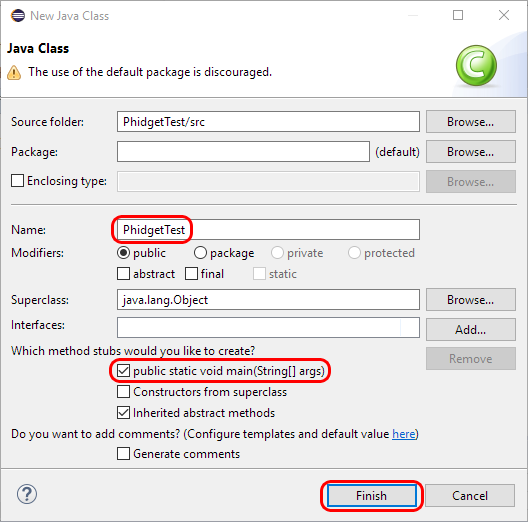
| | | | Name the class, and be sure to check the '''public static void main''' box. || [[Image:Windows_eclipse4.jpg|center|350px|link=https://cdn.phidgets.com/docs/images/8/87/Windows_eclipse4.jpg]] |
| Click ''Next >'' and add phidget22.jar to your project as an external jar:
| | |- |
| [[Image:Java_eclipse_linux_addjar.PNG|link=| center]] | | | Your project now has access to Phidgets! || |
| | | |- |
| | | |} |
| Finally, drag the example java file into the src folder that has been created for you and run the example:
| |
| | |
| [[Image:Java_eclipse_linux_run.png|link=|center]] | |
| | |
| | |
| Before you run the example, you may need to set up your Udev rules. An explanation on how to do this is provided on the Linux OS page, which can be accessed [[OS - Linux#Setting udev Rules | here]].
| |
| | |
| | |
| You should now have the example up and running for your device. Play around with the device and experiment with some of the functionality. When you are ready, the next step is configuring your project and writing your own code!
| |
| | |
| ====Configure Your Project==== | |
| When you are building a project from scratch, or adding Phidget functionality to an existing project, you'll need to configure your development environment to properly link the Phidget Java library.
| |
| | |
| | |
| To include the Phidget Java library, add the following import to the top of your code:
| |
| <syntaxhighlight lang="java">
| |
| import com.phidget22.*
| |
| </syntaxhighlight>
| |
| | |
| You can now create your project as shown in the previous section.
| |
| | |
| | |
| The project now has access to Phidgets. Next, view the [[#Write Code | write your own code]] section located below.
| |
| | |
| ==Write Code==
| |
| You've followed the instructions above for your operating system and now have a working example. Next, we will show you how the example was created and how it works by getting into the code. When you are ready, head to our [[Phidget Programming Basics]] page. There you will find code examples writen in Java and you will be writing your own code in no time!
| |
| | |
| == Further Reading ==
| |
| [[Phidget Programming Basics]] - Here you can find the basic concepts to help you get started with making your own programs that use Phidgets.
| |
|
| |
|
| [[Data Interval/Change Trigger]] - Learn about these two properties that control how much data comes in from your sensors.
| | === PhidgetSBC Web Interface === |
| | {| style="margin:auto;" class="table-no-border mw-collapsible mw-collapsed" |
| | |+'''Instructions''' |
| | |<center>{{#ev:youtube|gZmWvWXICIA|rel=0}}</center> |
| | |} |
|
| |
|
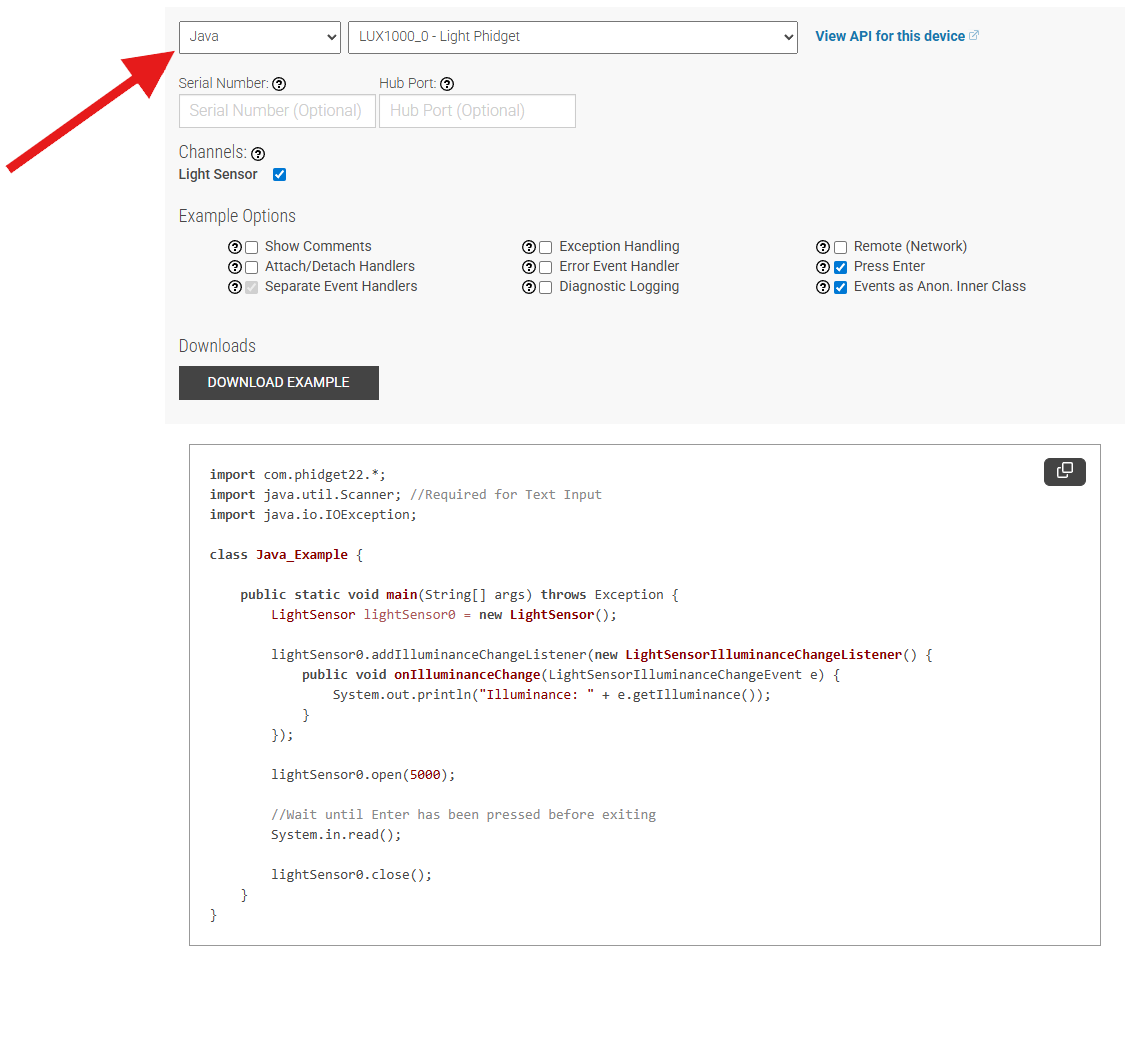
| [[Using Multiple Phidgets]] - It can be difficult to figure out how to use more than one Phidget in your program. This page will guide you through the steps. | | ==Example Code== |
| | Navigate to our [https://www.phidgets.com/?view=code_samples&lang=Java Code Sample Generator] to view and download code samples that are tailored to your specific device. |
|
| |
|
| [[Polling vs. Events]] - Your program can gather data in either a polling-driven or event-driven manner. Learn the difference to determine which is best for your application. | | [[Image:Language_java_codesample.png|center|600px|link=https://cdn.phidgets.com/docs/images/a/af/Language_java_codesample.png]] |
|
| |
|
| [[Logging, Exceptions, and Errors]] - Learn about all the tools you can use to debug your program.
| | ===Phidget Programming Basics=== |
| | {{PhidgetProgrammingBasicsLink}} |
|
| |
|
| [[Phidget Network Server]] - Phidgets can be controlled and communicated with over your network- either wirelessly or over ethernet. | | ==API== |
| | [{{SERVER}}/?view=api&lang=Python Phidget22 API] |